
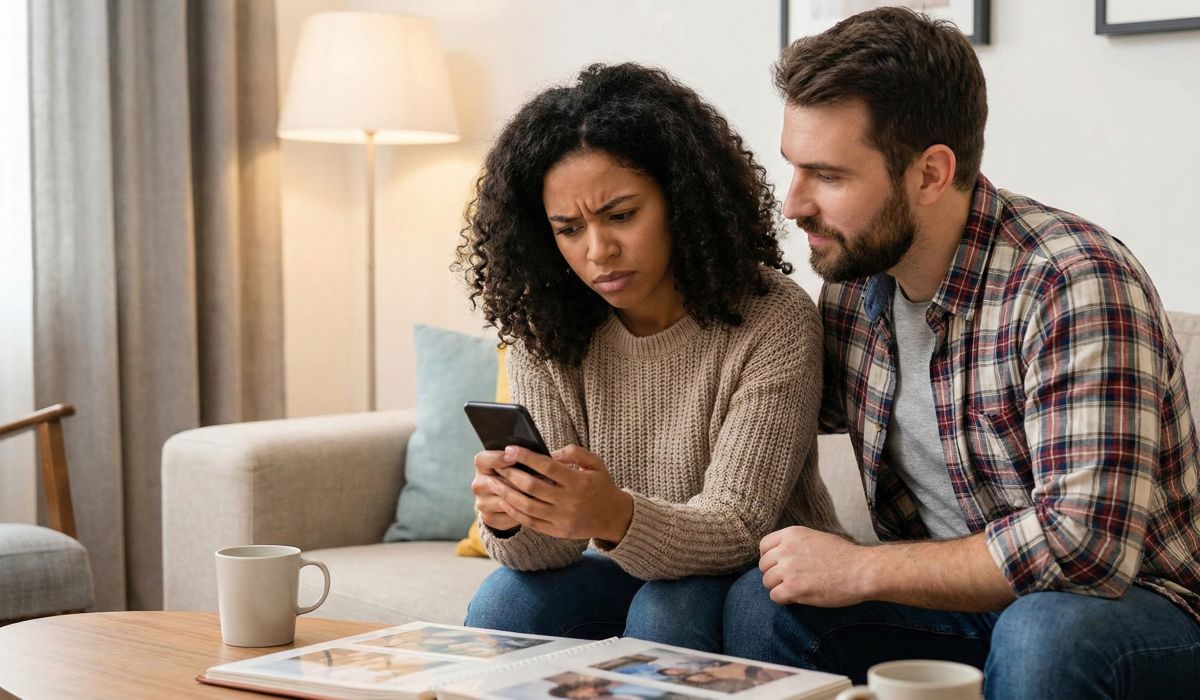
You are having a great night. You feel confident. Your outfit is on point. You are laughing with your partner or your friends, feeling light and happy.
Then, someone says, “Let’s take a picture!”
Table of Contents
You smile, you pose, and then you check the screen.
Your heart drops.
Is that what I look like? Is my arm really that big? Do I actually have a double chin?
The confidence evaporates instantly. You go from feeling like a 10 to feeling like you want to hide in the bathroom.
This experience is universal, yet we suffer through it alone. We let a collection of pixels dictate our self-worth.
Whether you are single and stressing over dating app photos, or in a relationship and dodging couple selfies, the camera anxiety is real.
But here is the secret: The camera is often a liar.
Learning how to navigate this visual world isn’t just about finding the right angle; it’s about understanding the difference between a 2D image and your 3D reality.
Key Takeaways
- Cameras distort reality: Focal length and lighting can drastically alter your proportions, often making you look wider than you are.
- You prefer the mirror: You are psychologically conditioned to prefer your reflection (the “Mere Exposure Effect”), so photos look “wrong” to you.
- Comparison is the thief of joy: Weighing more than your partner is a common insecurity, but it says nothing about your health or femininity.
- Posture changes everything: The quickest way to “look” thinner is often just un-slumping your shoulders.
- Confidence is physical: Taking up space confidently is actually more attractive than shrinking yourself.
What You Worry About: Am I Really as Fat as I Look in Pictures?
This is the question that haunts us at 2 AM.
You look in the mirror and see one thing, but the photo shows another. So, are you really as fat as you look in pictures?
The short and likely answer: No.
The long answer involves physics.
Cameras—especially smartphone cameras—use wide-angle lenses. These lenses are great for capturing a landscape, but terrible for portraits.
Wide-angle lenses create a distortion effect called “barrel distortion.” This stretches items at the center and edges of the frame. If you are standing on the edge of a group photo, you will look wider than the person in the middle. If your arm is closest to the lens, it will look massive compared to your body.
Furthermore, a photo flattens a three-dimensional human into a two-dimensional image. You lose the depth, the movement, and the life that makes you you.
You aren’t seeing reality; you are seeing a distorted, flattened map of reality.
The Psychology of the “Bad Side”
There is a reason you hate photos but tolerate the mirror.
It is called the Mere Exposure Effect.
You see your reflection in the mirror every single day. That reversed image is your “normal.”
A photograph, however, shows you the non-reversed version—the version the rest of the world sees. Because it doesn’t match the “you” in your head (the mirror you), your brain registers it as “wrong” or “ugly.”
This dysmorphia can bleed into your relationship.
If you are constantly deleting photos of you and your partner because you “look huge,” you are erasing memories. You are telling your partner that your appearance matters more than your shared joy.
If this anxiety about your appearance is causing tension or making you seek constant validation from your partner, it might be part of a deeper issue.
Read: How to Deal With Relationship Anxiety and Learn to Overcome It
What If I Weigh More Than My Boyfriend
For many women, this is the ultimate taboo.
We are raised on Disney movies where the Prince creates a protective envelope around the tiny Princess.
So, when you step on the scale and realize you weigh more than your partner, it can feel like a failure of femininity.
You might feel like you are “too big” to be held, or that you physically dominate him in photos.
1. Muscle vs. Fat
Men and women carry weight differently. If your boyfriend is a runner (lean) and you lift weights (dense muscle), you might weigh the same or more, even if you wear a smaller size.
2. Height Matters
If you are 5’9″ and he is 5’7″, you might weigh more simply because there is more of you. That is physics, not a character flaw.
3. The “Protector” Myth
Your partner’s ability to love, support, and protect you has zero to do with gravitational pull.
If you are letting this number stop you from being intimate or sitting on his lap, you are letting a number dictate your love life.
If you find yourself mirroring his eating habits to try and “shrink,” remember that men biologically burn calories differently.
Read: Why Do Females Gain Weight in a Relationship?
How to Look Thinner (Without Dieting)
Okay, we accept that cameras lie. But we still want to like our photos.
Here are practical, non-diet ways to align the photo with how you feel.
1. Posture is Paramount
Most of us slouch. Slouching compresses your torso, creating rolls that aren’t there when you stand tall.
- Roll your shoulders back and down.
- Lengthen your neck. Imagine a string pulling the top of your head.
2. Create Space
If you press your arm flat against your body, it squishes out, looking nearly double its size.
- The “Teapot” Pose: Place a hand on your hip to create a gap between your arm and torso.
- Turn 45 Degrees: Never face the camera head-on. turning slightly creates a narrower profile.
3. Dress for the Lens
Monochrome outfits create a long, vertical line. Avoid straps that cut into your skin or clothes that are too tight—not because you need to hide, but because clothes that fit properly smooth your silhouette.
How to Be Thinner (Feeling Lighter)
“Looking” thinner is about angles. “Being” thinner—or rather, feeling lighter and less weighed down—is about health.
If you feel heavy, sluggish, or uncomfortable in your skin, it is often inflammation or bloating, not fat.
1. Reduce the Sodium
If you have been eating out a lot on dates, you are likely retaining water. Cutting back on salt and drinking more water can drop that “puffy” feeling in 24 hours.
Read: How to Recover From Vacation Weight Gain
2. Move for Mood, Not Calories
When you exercise, you improve your circulation and lymphatic drainage. You stand taller. You feel stronger.
If you and your partner have fallen into a sedentary rut, getting moving again can change how you perceive your own body.
3. Stop the Comparison Scroll
If you spend hours looking at “perfect” couples on Instagram, you will always feel large and inadequate. Curate your feed.
The Relationship Impact
Your body image affects your relationship more than you think.
If you refuse to take photos, you are telling your partner, “I am not good enough to be seen with you.”
If you hide your body during sex, you are blocking intimacy.
If you constantly ask, “Do I look fat in this?”, you are placing the burden of your self-esteem on them.
Your partner is with you because they are attracted to you. They see the 3D version of you—the one that laughs, moves, and loves. They don’t see the “bad angle.”
It is important to know that you have the right to feel secure and loved, regardless of your size.
Conclusion
You are not a 2D image.
You are a living, breathing, dynamic human being.
The camera captures a millisecond of light and shadow; it does not capture your presence, your warmth, or your worth.
The next time you see a bad photo, don’t spiral. Laugh at the bad lighting, blame the wide-angle lens, and remember that the people who love you don’t look at you through a lens. They look at you with love.
FAQs
Does the camera add 10 pounds?
Yes, it effectively can. The “camera adds 10 pounds” is a real phenomenon caused by focal length. Telephoto lenses flatten features (making you look wider), and wide-angle lenses (like phone cameras) distort the edges. Additionally, binocular vision (two eyes) allows us to see depth around a person, slimming them; a camera (one eye) flattens everything into a wider shape.
Why do I feel skinny but look fat?
This is usually a disconnect between your internal body image (proprioception) and the visual evidence of a photo. You might feel strong, energized, and lean, but a photo caught you at a bad angle or with poor posture. Trust the feeling. How you feel in your body is a much more accurate indicator of health than a snapshot.
Why do I look bigger in group photos?
If you are on the edge of the frame, the lens distortion will stretch you horizontally. Always try to stand near the center of the group photo to get the most accurate representation of your size.
How do I stop hating my wedding/couple photos?
Stop zooming in. When we look at photos, we tend to zoom in on our “flaws” while ignoring the context. Look at the emotion in the photo. Look at your partner’s smile. Focus on the memory, not the arm fat.
References
- Gilovich, T., Medvec, V. H., & Savitsky, K. (2000). The spotlight effect in social judgment: An egocentric bias in estimates of the salience of one’s own actions and appearance. Journal of Personality and Social Psychology.
- Zajonc, R. B. (1968). Attitudinal effects of mere exposure. Journal of Personality and Social Psychology.
- Groesz, L. M., Levine, M. P., & Murnen, S. K. (2002). The effect of experimental presentation of thin media images on body satisfaction: A meta-analytic review. International Journal of Eating Disorders.